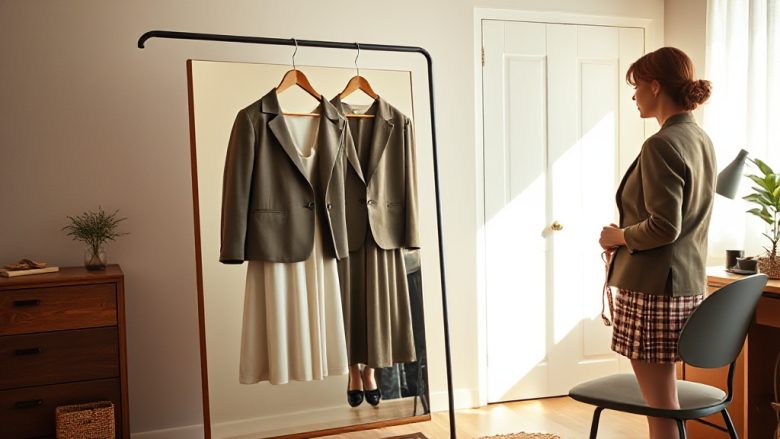
You found the dress. Maybe it’s a 1970s prairie number with a collar that could double as a kite, or a 1950s circle skirt in a print so loud it announces you before you speak. You put it on, look in the mirror, and something is wrong. You don’t look like someone who wears vintage. You look like someone who dressed up as someone who wears vintage. I know this feeling because I lived in it for years. My first vintage coat made me look like a museum docent. My first vintage dress made me look like I was heading to a themed birthday party no one else had been invited to. Learning how to improve your vintage fashion is mostly a diagnostic skill. Something is off, and the fix is usually one of three things: fit, fabric, or how you style it. This is a troubleshooting guide for all three.
Problem One: The Fit Is Wrong, So the Whole Outfit Reads as Fancy Dress
Vintage sizing is not modern sizing, and this trips up almost everyone at the start. A vintage size 12 is not a modern size 12. A garment made in 1968 was cut for a body that had different proportions, different undergarments, and often a different posture. When you pull a vintage piece over your modern frame and it technically closes, that does not mean it fits. It means it survived the journey. A waist seam that sits two inches above your natural waist, shoulder seams that hang past your shoulder bone, or a hem that hits at an awkward mid-calf point will make even a beautiful piece look borrowed. That borrowed feeling is what reads as costume.
The fix starts with knowing your measurements and ignoring the label entirely. Measure your bust, waist, hips, shoulder width, and the length from shoulder to waist. Write those numbers down. When you shop, compare the garment’s actual measurements against your own, not the size on the tag. A piece that is slightly too big can be taken in at the seams. A piece that is too small in the shoulders or the bust is usually a lost cause, because those areas are the hardest and most expensive to alter. Shoulders are the one measurement you should never compromise on.
Then find a tailor who actually understands vintage construction. Not every alterations shop does. Older garments often have seam allowances that are narrow or already let out once, linings that are attached in unusual ways, and fabrics that behave differently under a needle. Ask specifically whether they have worked with vintage before. A good tailor can shorten a hem, take in a waist, or adjust a shoulder line, and those three small changes are often the difference between a piece that looks like a costume and a piece that looks like it was made for you. If a garment needs more than two or three alterations to work, it is probably not the right piece, no matter how much you love the fabric.
One more fit note: underpinnings matter more than most people admit. Vintage silhouettes were built on specific foundations. A 1950s dress with a nipped waist was designed to be worn over a girdle or structured slip. You don’t need to recreate the entire history of undergarments, but a simple modern shaping slip or a well-fitted bra can change how a dress sits on your body. The goal is not to change your shape. It is to give the garment the support it was cut to expect.
Problem Two: The Fabric and Condition Are Working Against You
Here is the thing nobody tells you when you start buying vintage: some fabrics age beautifully, and some age into sadness. Wool, linen, silk, and good cotton can last decades and often improve with wear. But certain synthetics from the 1960s and 1970s pill, sag, or develop a shine that no amount of steaming will fix. A garment can be structurally intact and still look tired. That tiredness transfers to you. You put it on and suddenly you look like you are wearing a costume that has been in an attic.
Before you buy, look closely at the fabric in good light. Check the underarms for discoloration and the seams for strain. Hold it up and see whether the drape is still soft or whether it has gone stiff and papery. Stains that have set for years are often permanent, and while a good dry cleaner can work miracles, they cannot resurrect fabric that has lost its structure. If the material feels brittle or the color has faded unevenly, walk away. There will be another piece.
If you already own something that looks off, try a careful refresh before you give up on it. A gentle hand wash or a professional clean can lift years of grime that you didn’t even notice was dulling the color. Steam rather than iron, especially on delicate fabrics, because a heavy iron can flatten texture and leave shine marks. Replace missing buttons with period-appropriate ones, and repair small tears before they spread. Sometimes the problem is not the garment at all but the fact that it has been sitting unloved in a wardrobe for a decade.
There is also a category of vintage that simply should not be worn as clothing. Fragile lace, heavily beaded pieces from the 1920s, and anything with active deterioration are better as display pieces or as fabric to be repurposed. Wearing them risks destroying them. Knowing when to stop is part of improving your vintage fashion, not a failure of it.
Problem Three: The Styling Makes Everything Look Like a Theme
This is the most common problem and the easiest to fix. When people first get into vintage, they tend to wear it head to toe. Vintage dress, vintage shoes, vintage bag, vintage gloves, vintage hat. The result is not a look. It is a time period. And a full time period reads as costume, because nobody in that actual decade wore only things from that decade. They mixed old and new just like we do.
The fix is to anchor one vintage piece with modern ones. If you are wearing a 1960s mod dress, pair it with plain modern tights and simple contemporary shoes. If you are wearing a vintage blazer, put it over a basic modern t-shirt and jeans. The contrast is what makes the vintage piece look intentional rather than theatrical. One statement piece, everything else quiet. That is the formula, and it works almost every time.
Accessories are where most outfits go wrong. A single well-chosen vintage accessory, like a scarf or a pair of earrings, adds character. A full set of matching vintage accessories adds a costume. Pick one, and let it be the thing people notice. If you want to wear more than one vintage element, make sure they are from different eras or different registers, so the outfit reads as personal style rather than period reenactment. A 1940s jacket with 1990s jeans is a look. A 1940s jacket with 1940s trousers, hat, and shoes is a costume.
Hair and makeup matter too, and this is where a lot of people accidentally tip into costume territory. You do not need to recreate a period beauty look to wear a period garment. Modern hair with vintage clothing often looks more sophisticated than a full retro styling. If you do want to nod to the era, keep it subtle. A red lip with a 1950s dress is enough. You don’t also need a set-curl and a pillbox hat.
Putting the Diagnostic to Work
Next time a vintage outfit looks off, run through the three checks in order. First, look at the fit. Are the shoulders sitting where they should? Is the waist hitting your natural waist? If not, that is your problem, and a tailor can often solve it. Second, look at the fabric and condition. Is the material tired, shiny, or stained? If so, a clean or a repair might save it, or it might be time to let it go. Third, look at the styling. Are you wearing one vintage piece or five? If it is five, take four off and see what happens.
Most of the time, the answer is a combination of a small alteration and a simpler styling choice. Vintage fashion looks best when it looks lived in, not performed. The people who wear it well are not the ones with the most authentic pieces. They are the ones who know how to make an old garment feel like it belongs to them. That is a skill you build by making the mistakes first, and then learning which small adjustments actually matter. Start with fit, then fabric, then styling. Fix those three, and the costume feeling disappears. What is left is just you, in a great old dress, looking like you have always worn it.